Food Paper Bags
View →

A practical guide to food packaging in Ghana, covering common formats, food-specific requirements, sustainability, food safety and how to choose packaging that works in real service
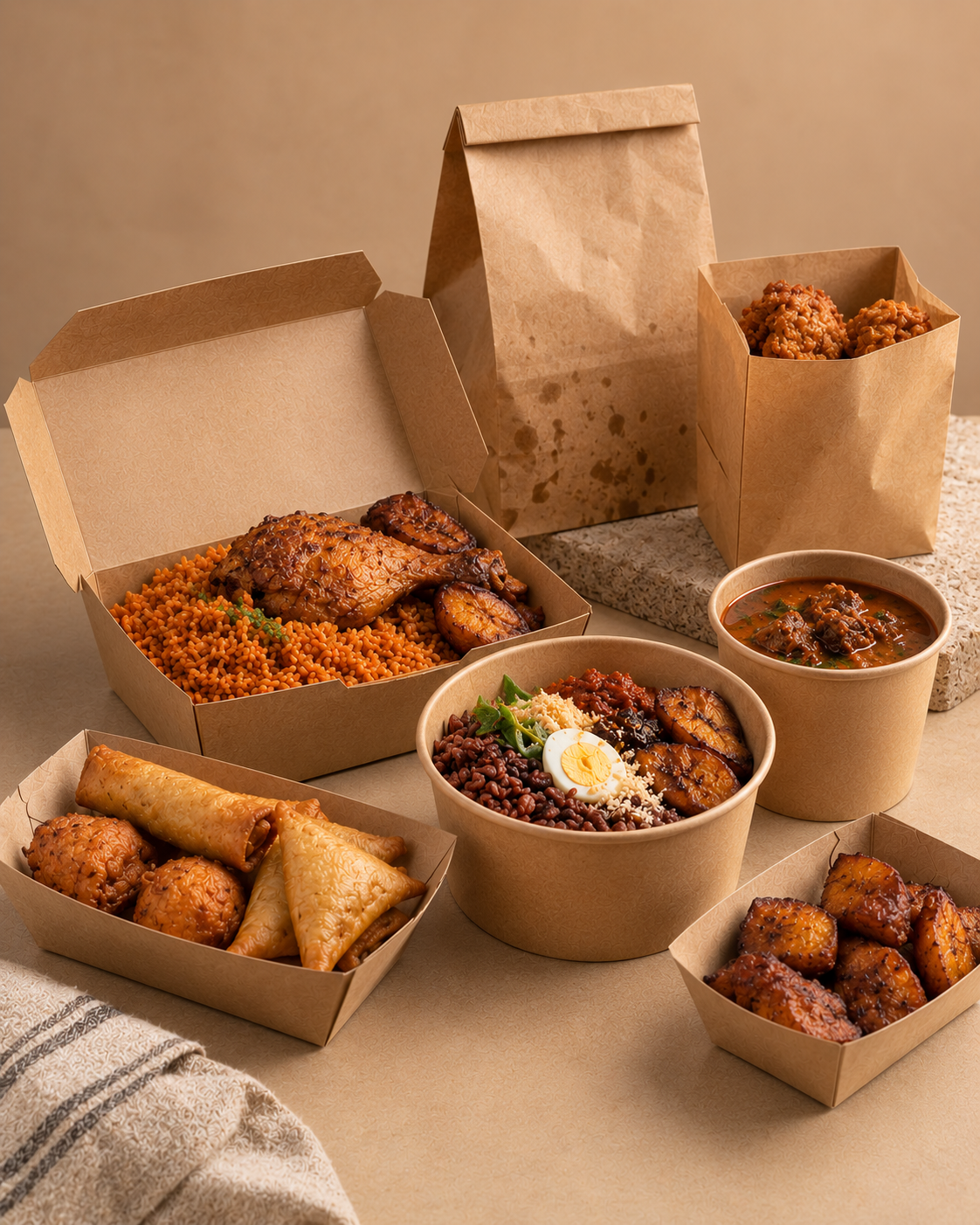
Food packaging is the material or container used to protect, hold, serve, transport or present food. In food service, that can include takeaway boxes, paper bags, trays, bowls, cups, wraps and carrier bags.
Good food packaging has to solve several problems at once: protect the food, handle the expected heat and moisture, contain grease or sauce where required, survive handling and transport, and make service practical for the business.
For a business considering a more sustainable packaging system, the objective is not simply to swap one material for another. The better approach is to select the right format and specification for the food while reducing unnecessary material and choosing a more responsible option where practical.
Ghana's food businesses operate in very different conditions. A restaurant delivering jollof across town has different packaging requirements from a vendor serving kelewele immediately, a caterer preparing finger foods for an event or a bakery selling pastries.
There is therefore no single “best” food package.
Common food-service formats include:
The sustainable choice depends on the job the package must perform. A package that looks environmentally preferable but leaks, collapses or fails with hot food is not a better operational solution.
Takeaway boxes are suited to prepared meals that need protection during pickup or delivery. Depending on construction and specification, they can work for rice meals, fried foods, combinations and other takeaway portions.
Businesses should assess heat, grease, moisture, closure, portion size, stacking, assembly and transport requirements before selecting a box.
Best suited for: restaurants, chop bars, fast-food businesses, caterers and delivery-focused food brands.
Kraft paper trays are useful when food needs to be served rather than tightly enclosed. They can work particularly well for fried foods, snacks, finger foods and event servings.
For bars, event vendors and caterers, tray applications can include kelewele, gizzard, chicken, fried yam, samosas, spring rolls and other savouries.
Best suited for: street food vendors, bars, event vendors, caterers, and snack businesses.
Paper food bags can be used for pastries, snacks, chips, popcorn, sandwiches and other suitable foods. The paper grade and construction should match the food, especially where grease or moisture is involved.
They also provide a simple surface for branding, allowing the package to become part of the customer experience.
Best suited for: bakeries, cafés, snack businesses, restaurants, street-food vendors and retail food brands.
Bowls provide more depth than trays and can suit selected meals, sides, salads, desserts and other foods. For hot or saucy food, construction and barrier properties matter, so the actual package should be tested with the intended food before bulk purchasing.
Best suited for: restaurants, delivery businesses, caterers and food vendors.
Food cups can be useful for soups, sauces, desserts and portioned foods. Temperature, liquid content, lid compatibility and transport stability should all be considered.
A paper component alone does not determine the environmental profile of the complete package. Coatings, liners, lids and end-of-life options also matter.
Wrap papers can avoid the need for a rigid container when the food does not require one. They can be suitable for burgers, wraps, sandwiches and selected takeaway foods.
The paper specification should reflect the food's moisture and grease characteristics.
Rice meals often combine heat, moisture, sauces and multiple sides. Packaging should therefore be selected for the actual meal and portion rather than the food name alone.
A suitable box, bowl or other food-contact format should be assessed for heat, sauce, grease, leakage, portion size and transport. For waakye and similar local meals, businesses should test the package with the real combination of rice, stew, protein and sides before committing to a large order.
Fried foods introduce grease and steam. Trays, suitable paper bags and other formats can work depending on portion size and whether the food is being served immediately or transported.
Ventilation and grease management can matter as much as the material because trapped steam and condensation can affect food quality and packaging performance.
Chicken, chips, grilled foods and similar products need packaging that can handle the expected heat, grease and handling. Boxes, trays and bags may each be appropriate in different situations.
Liquid foods require packaging designed specifically for containment. Depth, closure, leak resistance and transport stability are critical. A paper package should never be assumed suitable for liquids simply because it is made from paper.
Bakeries may use bags, boxes, trays and other formats depending on the product. Dry pastries generally have different packaging requirements from cream-filled, delicate or moisture-sensitive products.
Lightweight bags, boxes and trays can work well for snacks. Popcorn can use a dedicated box format that supports portioning, presentation and branding.
For weddings, funerals, parties, corporate events and outdoor gatherings, trays and snack formats can make serving easier while balancing presentation, carrying convenience and waste management.
Restaurants: often need a coordinated takeaway system rather than one universal package. Boxes, trays, bags, wraps and bowls can cover different menu items while maintaining a consistent brand experience.
Street-food vendors: need practical packaging that is easy to use, affordable at their operating volume and suited to their food. Sustainability should be built into the practical decision rather than treated as a luxury upgrade.
Caterers: need packaging that works across quantities, menu types and event formats. Presentation, transport and serving efficiency are particularly important.
Fast-food brands: benefit from standardised sizes and formats that simplify purchasing, storage, assembly and staff training.
Bakeries and cafés: commonly need combinations of bags, boxes, cups and carrier bags, selected around the sensitivity of each product.
Bars and event vendors: often serve savouries and finger foods alongside drinks. Trays and snack formats can work well for kelewele, gizzard, chicken, suya/chinchinga, fried yam, samosas and spring rolls.
“Sustainable packaging” is not one material and should not be treated as a blanket marketing claim.
A better assessment considers the material, amount of material used, production, durability, food-waste implications, reuse or recycling potential and realistic end-of-life options in the market.
Paper and kraft formats can be useful parts of a lower-plastic packaging strategy. However, the complete construction matters. Coatings, liners, lids and mixed materials can affect the environmental profile and disposal pathway.
Where supply allows, businesses can also investigate responsibly sourced or recycled-content paperboard and ask suppliers for material specifications rather than relying on unsupported environmental claims.
PacLabs principle: paper-first where the application makes sense, performance-first where food protection requires it, and evidence-first when making environmental claims.
Ghana's food-packaging market is entering an important transition. The Environmental Protection Authority announced a nationwide ban on the production, importation, sale and use of Styrofoam products effective January 1, 2027, including expanded-polystyrene food packaging and takeaway packs. [1]
In August 2026, the EPA described the Styrofoam ban as the first phase of a broader strategy targeting non-biodegradable single-use plastics. Market monitoring at Kejetia and Makola found traders already stocking alternatives including paper-based packaging, recycled aluminium foil, recyclable plastic and packaging made from agricultural by-products. The EPA also referenced local foods such as waakye and kenkey when discussing the transition. [2]
For a food business, the useful question is therefore not simply “What replaces Styrofoam?” It is:
What packaging can replace my current pack while still protecting my food, fitting my portion, surviving delivery and moving my business toward a more responsible packaging system?
The answer will differ by food, portion, service method and budget.
PacLabs should use dedicated replacement and industry pages to answer those specific scenarios rather than turning this broad guide into a collection of product-specific answers.
Sustainability cannot replace food safety. Packaging used with food should be suitable for the intended application and handled in a way that prevents contamination.
Ghana Food and Drugs Authority guidance states that packaging materials should be stored cleanly and sanitarily and should not transmit objectionable substances to food. Packaging operations should also be carried out under conditions that prevent contamination. [3]
Businesses should therefore ask about food-contact suitability, intended use, material specification and handling requirements rather than choosing packaging on appearance alone.
There is no universal price for food packaging. Cost can change with:
For custom packaging, compare equivalent specifications rather than comparing a single unit price across packages that perform different jobs.
Common food-service formats include takeaway boxes, paper bags, trays, bowls, cups, wraps and carrier bags. The right option depends on the food, portion, service method and transport conditions.
There is no universal best option. The package should match the food's heat, moisture, grease, portion and transport requirements. An appropriately specified paper or kraft format can be a practical lower-plastic option for many applications.
Hot food requires packaging designed for the expected temperature and food characteristics. Always validate the actual package with the intended food, particularly when sauce, grease or steam is involved.
Kraft paper and paperboard can be used for formats such as bags, trays, boxes and other food-service packaging. Suitability depends on the grade, construction, barrier properties and intended application.
Start with the food, portion, heat, moisture, grease, leakage, transport and cost requirements. Then evaluate suitable alternatives and test them under real operating conditions.
Practical points to apply before your next packaging decision.
Formats and solutions referenced in this guide.
Continue reading across materials, branding, and operations.
Share your product, volumes, and timeline, and we will recommend materials, formats, and print options that fit your operation.